

Thank you for Subscribing to Media Entertainment Business Review Weekly Brief
Media Entertainment Business Review: Specials Magazine

PANDA Stronger
Revolutionizing Sports Management with Data Analytics
The youth sports landscape is characterized by varying levels of accessibility, efficiency, and cost, which presents the need for a solution that enables talented athletes to shine. Enter PANDA Stronger, a specialized platform crafted to address these issues, especially at the youth level. An acronym for performance, analytics, and data, PANDA Stronger is a game-changing solution that bridges the divide between coaches, athletes, parents, and colleges. By focusing on unity, efficiency, and affordability, it redefines how the entire athletic ecosystem interacts and grows. “PANDA Stronger is like an amalgamation of LinkedIn, Instagram, WhatsApp, and Moneyball with youth sports, or simply—data analytics meets social networking," says D. Glen Parillo, founder, chairman, CEO, and CFO of PANDA Stronger. This allows the platform to solve existing inefficiencies by integrating team management, individual profile management, college recruiting, social networking, and social media into one ecosystem. But PANDA Stronger isn't just a management tool; it's a platform for self-improvement and growth. With a proprietary algorithm capable of calculating a person's athleticism, athletes can now quantify and compare their performance against their peers. Drawing analytical comparisons akin to fantasy sports, the platform uses data from over 340 customizable workouts. From tracking daily workouts to analyzing strengths and weaknesses, this robust system helps athletes understand where to improve.

Publishing Services
Level 4 Press
Books Destined for the Big Screen
William Roetzheim, CEO; Randy Becker, Executive Vice President, Justin Steger, Film and Television Executive
Over one-third of the movies made in Hollywood in the last 60 years have been based on books, and many of them have gone on to become blockbusters. While some of these books are renowned franchises, others are lesser-known literary works chosen from the four million books published annually. Until now, investors in the entertainment industry have spent extensive resources trying to find novels that check all the boxes for a successful adaptation. Level 4 Press has introduced a better alternative to connect distinctive literary works with film and television buyers looking for their next blockbuster. The robust book-to-screen pipeline designed by Level 4 Press reverse-engineers the process of adapting books to the silver screen. Rather than trying to find a suitable novel from the hundreds of thousands of published works, Level 4 Press employs skilled writers to develop original ideas. It identifies a suitable idea for a film or television series, then assigns an author to flesh it ou

Top Media Supply Chain Quality Control and Digitization Solutions

GrayMeta
The Gold Standard of Media QC: From Frame One to Final Delivery
Mark Gray, President and CEO
Behind every hit show on a streaming platform and every reel of history preserved in the Library of Congress lies a complex, meticulous process—one that ensures not just quality, but longevity. Studios, streamers, and broadcasters handle thousands of file-based deliveries each week, and universities and institutions digitizing analog videotape archives is a high-impact process where every frame needs to be preserved with the utmost quality. GrayMeta, a market leader in media supply chain quality control and videotape archive digitization applications, has been doing this heavy lifting for more than a decade. A team of world-class video engineers led by industry-renowned leaders, like Chi-Long Tsang CTO, continues to fuel the GrayMeta engine. The initial applications were focused on “eyes-on-glass” manual QC. Now, with cloud infrastructure, the rapid increase in streaming and the options for automated QC, GrayMeta continues to expand with features to support the modern production chain. “What we’re really seeing is that as content moves faster and pipelines get more complex; studios need more than just technical QC— they need intelligence across the entire media lifecycle. That’s where we’re stepping in,” says Mark Gray, president and CEO. GrayMeta has essentially miniaturized what used to be a hundred-thousand-dollar level investment for a hardware-based QC room down to software usable on most any desktop, anywhere in the organization—thanks to a flexible licensing system. It’s a big shift in how teams can work. Daniel Daube, VP Customer Success, further explains the value of GrayMeta’s current solution development trajectory. “Our tools aren’t just catching errors— they’re helping teams understand and validate asset metadata, why versions differ, and how to stay compliant in a streaming-first world. We’re not just one part of the workflow anymore, we're solving problems across the entire process.”
Cinema and Film Technologies

Latest Technologies and Arena Sports Entertainment: A Heavenly Combination for Delightful Fan Experience
Ryan Gonzales, Senior Director and Producer of Broadcast Services, Kroenke Sports and Entertainment
Cinema and Film Technologies

Delivering Entertainment That Resonates Across Audience Identities & Screens
JP Evangelista, Executive Vice-President, Content, Programming & Marketing, Vevo
Podcasting

Leading a Team Remotely- Across Countries, Cultures, and the Internet
John Barnett, Director of Production, Cirque du Soleil Entertainment Group
AR/VR Platforms

Equipment Management and Vendor Relations for Long-Term Media Success
Miles Dean Ewell, Head of Media & Production Technology, Vox Media, Inc
AR/VR Platforms

How Social Media is Shaping Modern Entertainment
Christian Printup, Vice President of Entertainment, Foxwoods Resort Casino
Entertainment

All For One And One For All
Patrick Magee, Director, Audio Post-Production/Scripps Networks, The E.W. Scripps Company
Media Buying Services

New Year, Bold Approach: Turning Human Resources into a People-First Experience
Maria Neve, Senior Vice President of People Experience, Sony Music Entertainment

IN MY OPINION
Podcasting
The Changing Face of Entertainment in All-Inclusive Hotels
Miguel Coronel, Head of Entertainment, Hilton

LAST WORD
Sports Products and Accessories
Building a Forwarding-Thinking Media Production Facility
Mike Strein, Director, Engineering and Technology, ABC News
IN FOCUS

Popular Trends Propelling Developments in Gaming
The evolution of gaming technology has significantly altered not just gameplay but also approaches to learning and work.
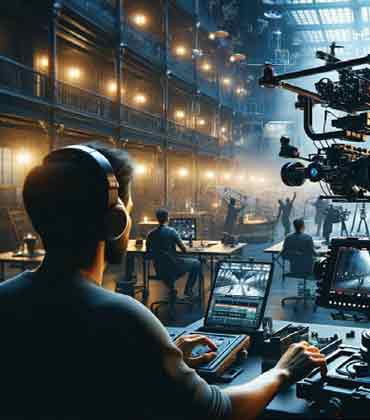
The Impact of AI on the Video Industry: Innovations Driving Change
The video industry has undergone a remarkable transformation recently, primarily driven by technological advancements.
EDITORIAL
Next-Gen Broadcast Solutions to Meet Changing Audience Expectations
The media and entertainment industry is experiencing a digital renaissance, fueled by evolving consumer expectations and rapid technological advancements. The rise of streaming, interactive experiences and on-demand content has fundamentally changed how audiences engage with media, pushing broadcasters to innovate at an unprecedented pace.
At the center of this transformation is broadcast equipment, which is undergoing a revolution to keep up with shifting industry demands. Next-generation audio and immersive sound are revolutionizing how audiences engage with content. Spatial audio, Dolby Atmos and AI-driven sound mixing are elevating the experience of entertainment, creating a new standard for realism and depth. Meanwhile, the adoption of 4K, 8K and HDR technologies is pushing the boundaries of visual clarity, offering unparalleled resolution and dynamic color grading that cater to audiences’ growing expectations for ultra-high-definition content.
At the core of this transformation is the shift to IP-based broadcasting and cloud workflows. Broadcasters are replacing traditional SDI infrastructure with flexible, scalable IP networks, enabling remote production and seamless multi-platform delivery. Cloud-based solutions are streamlining content management by reducing costs and enhancing operational agility.
Driven by these trends, the media and entertainment industry is poised to reach $46.89 billion by 2030, growing at a CAGR of 7.8 percent.
This edition provides insights into recent developments in media and entertainment and how companies offer services aligned with the latest trends.
The magazine features a thought leadership article from Patrick Magee, Director of Audio Post-Production and Scripps Networks at The E.W. Scripps Company. The article highlights the importance of the evolving role of audio post-production professionals who, driven by industry shifts and advancing technology, embrace hybrid skill sets to remain competitive and adapt to the ever-changing landscape of sound design, editing, and mixing.
It also includes insight from industry expert Miles Dean Ewell, Senior Director of Production Technology at Vox Media, Inc., who sheds light on the strategic adoption of broadcast technology, balancing cutting-edge innovations with practical, long-term solutions prioritizing adaptability and creative problem-solving to meet evolving industry demands.
