


Thank you for Subscribing to Media Entertainment Business Review Weekly Brief
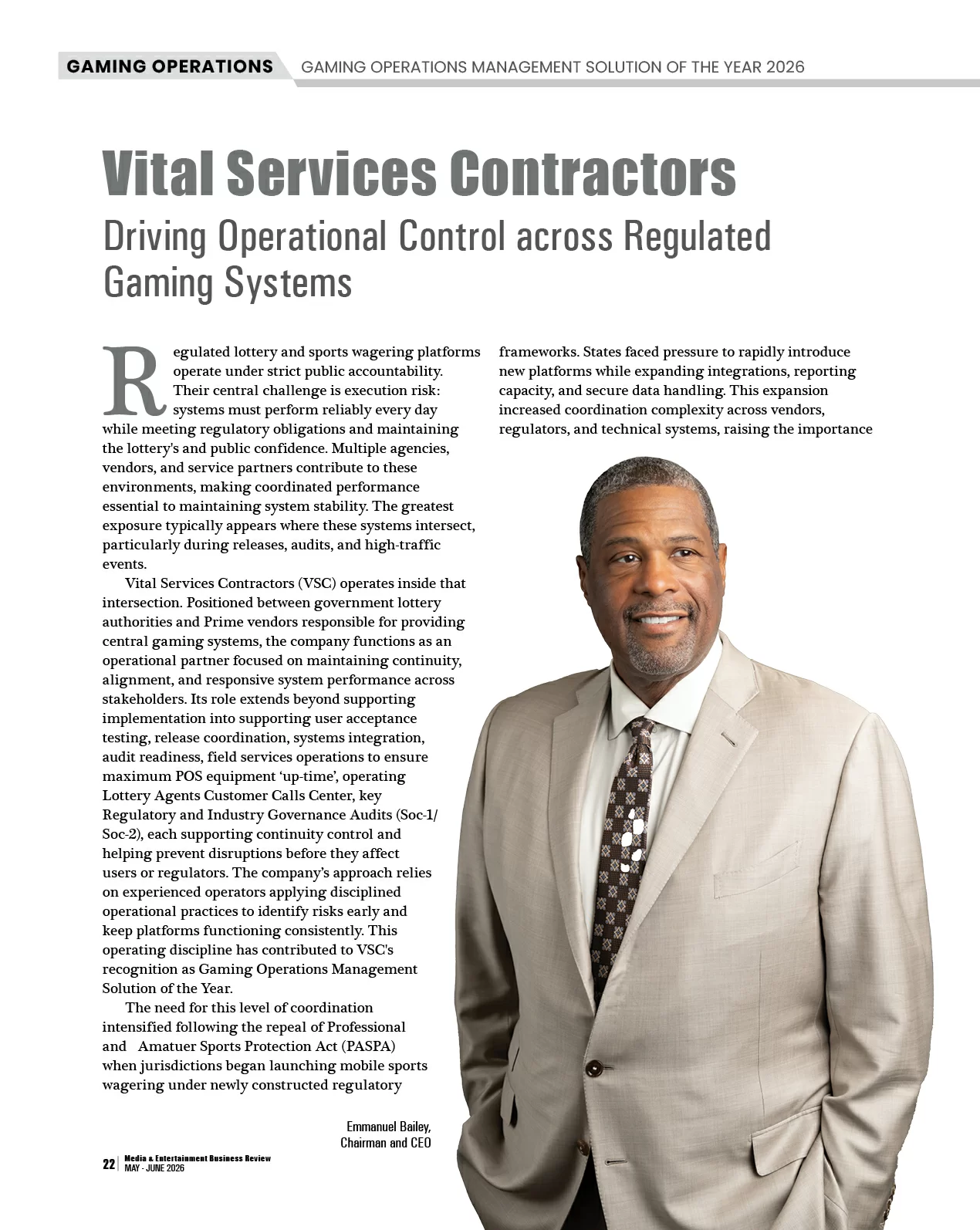
 Emmanuel Bailey, Chairman and CEO
What challenges arise in maintaining operational continuity across regulated gaming system environments?
Regulated lottery and sports wagering platforms operate under strict public accountability. Their central challenge is execution risk: systems must perform reliably every day while meeting regulatory obligations and maintaining the lottery's and public confidence. Multiple agencies, vendors, and service partners contribute to these environments, making coordinated performance essential to maintaining system stability. The greatest exposure typically appears where these systems intersect, particularly during releases, audits, and high-traffic events.
Vital Services Contractors (VSC) operates inside that intersection. Positioned between government lottery authorities and Prime vendors responsible for providing central gaming systems, the company functions as an operational partner focused on maintaining continuity, alignment, and responsive system performance across stakeholders. Its role extends beyond supporting implementation into supporting user acceptance testing, release coordination, systems integration, audit readiness, field services operations to ensure maximum POS equipment ‘up-time’, operating Lottery Agents Customer Calls Center, key Regulatory and Industry Governance Audits (Soc-1/ Soc-2), each supporting continuity control and helping prevent disruptions before they affect users or regulators. The company’s approach relies on experienced operators applying disciplined operational practices to identify risks early and keep platforms functioning consistently. This operating discipline has contributed to VSC's recognition as Gaming Operations Management Solution of the Year.
The need for this level of coordination intensified following the repeal of Professional and Amatuer Sports Protection Act (PASPA) when jurisdictions began launching mobile sports wagering under newly constructed regulatory frameworks. States faced pressure to rapidly introduce new platforms while expanding integrations, reporting capacity, and secure data handling. This expansion increased coordination complexity across vendors, regulators, and technical systems, raising the importance of stable rollout management. In response, VSC embedded additional monitoring routines, coordination checkpoints, and escalation pathways into daily operations to support controlled scaling and dependable system performance.
“Our industry does not allow room for ambiguity,” says Emmanuel Bailey, Chairman and CEO. “When you are operating in a public-facing gaming environment, every decision sits inside a regulatory framework and each gap carries consequences. Our responsibility is to make sure those gaps are identified and resolved before they surface.”
The company links its results to this structured operational approach, which supports accountability across interconnected systems.
Governing Execution across Complex Systems
How does VSC manage coordination between vendors, regulators, and systems during critical operations?
VSC works between state lottery authorities and the global vendors that supply central gaming systems. Each party carries distinct responsibilities, yet continuity depends on coordinated action during releases, upgrades, and incident response. Misalignment at these intersections can introduce risks that neither side independently controls, particularly during high-traffic events or reporting cycles.
The company maintains real-time visibility across these touchpoints to detect integration gaps early and protect operational stability. Release milestones are tracked against contractual deliverables to ensure emerging issues are corrected before they affect platform reliability. Defects are escalated through defined channels to contain potential disruptions while they remain manageable. Stakeholder reporting confirms that corrective actions are completed and documented, while supplemental internal tools help maintain alignment across environments that were not originally designed to operate together. Together, these practices strengthen continuity assurance by keeping risks visible and actionable before they escalate into operational or compliance problems.
-
Our industry does not allow room for ambiguity. When you are operating in a public-facing gaming environment, every decision sits inside a regulatory framework and each gap carries consequences. Our responsibility is to make sure those gaps are identified and resolved before they surface.
“We sit in the middle of multiple systems that were not built together. Our responsibility is to ensure that integrations and operational workflows align with the jurisdiction’s standards. That requires disciplined tracking and clear escalation,” says Vassilis Hadjidiakos, CFO.
When material risks remain unresolved at the vendor level, VSC elevates findings to the contracting authority in accordance with the statement of work, a necessary step to protect operational continuity. This step ensures jurisdictions gain timely visibility and can intervene before issues affect system stability or audit outcomes.
Audit Discipline and Controlled Continuity
Why are audit processes essential for maintaining transparency and reliability in regulated gaming operations?
Operational control and transparency in regulated gaming are reinforced through continuous external review. The contract that VSC supports and operates are subject to recurring independent audits, including SOC 1 and SOC 2 examinations that evaluate internal controls, data handling, and reporting integrity. Financial audits, vendor reviews, and jurisdiction-specific compliance assessments occur throughout the year. These reviews play a practical role in verifying that operational controls remain dependable under real- world conditions and that reporting remains defensible when scrutinized.
 Serialized ticket management illustrates the level of exposure involved. Millions of dollars in printed tickets move through controlled distribution channels, each unit traceable and subject to reconciliation. This serves as one visible example of the broader obligation to maintain verifiable oversight across assets, transactions, and system activity. Effective oversight requires documented chain-of-custody controls, retrievable records, and defined authority for system access. Incident reporting obligations also require that material disruptions be disclosed within mandated timeframes, often within 48 hours, reinforcing operational accountability and transparency.
“All contract deliverables are assigned, documented, and audited internally before they are ever reviewed externally,” says Kelly Allen, Senior Technical Delivery Manager. “Our responsibility is to ensure that continuity plans, reporting protocols, and escalation paths are clearly defined before an issue arises.”
Administrative access is monitored. Changes move through authorization workflows. Internal reviews precede external examinations. In select jurisdictions, VSC also supports retail network oversight and marketing coordination, aligning field execution with central system controls. Collectively, these measures reinforce system reliability, early issue detection, and transparent communication with regulators and partners.
Managing Risk Under Public Scrutiny
In what way does structured oversight support risk management during high-visibility system launches?
High-visibility launches place operational control under direct stress. That dynamic was evident during the District of Columbia’s post-PASPA sports wagering launch. The jurisdiction introduced a lottery-operated mobile betting platform, while national operators aggressively expanded across newly legalized markets. The rollout required coordination among government stakeholders, a global systems vendor deploying a new central gaming environment, and multiple technical teams working across time zones—all under heightened public visibility and competitive pressure.
VSC's role extends beyond release coordination. The company participated in brand development discussions, secured domain protections, and contributed to user interface refinement through structured review cycles. Internally, its team tracked integration gaps and documented risks as the platform moved toward launch, helping surface operational concerns early enough for corrective action.
“The launch brought together a new regulatory framework, a de nova platform, and national visibility all at once,” says Bailey. “In that environment, structured oversight becomes the safeguard.”
That safeguard was tested during a high-traffic Super Bowl period, when the mobile application encountered an SSL certificate issue that threatened service continuity during peak usage. VSC identified the exposure through its review processes and escalated the matter through appropriate technical channels, enabling remediation before the disruption extended into a prolonged outage. Service was restored within hours, preserving platform availability during a period of heightened public attention. At that scale, even a short interruption could have affected launch confidence and increased regulatory scrutiny, making rapid coordination essential. The response demonstrated the company’s operating method: detect risks early, escalate clearly, and coordinate resolution quickly to maintain continuity.
Experience Anchored in Institutional Knowledge
VSC's operational approach is reinforced by the depth of experience inside the company. Senior leaders have served within state lottery authorities, global central gaming vendors, and large technology companies. This breadth of experience allows the team to anticipate integration challenges, interpret regulatory expectations accurately, and respond decisively when operational pressure increases.
“For a firm of our size, the collective experience across this team is significant. Many of us have worked inside these systems for decades, and our clients know that history,” says Stephen Beck, General Manager and Senior Vice President.
As a mid-market organization, VSC focuses on translating its experience into practical support for clients, particularly those in highly regulated lottery environments. This familiarity allows for more direct engagement with regulators and vendor partners when operational issues arise and deadlines become tight.
In regulated gaming systems shaped by public accountability and financial exposure, stability depends on effective operational control. VSC focuses on the operational coordination points where vendors, regulators, and gaming systems intersect, helping jurisdictions maintain continuity and control.
Disciplined Execution in Modern Gaming Operations Management
Gaming platforms that manage lotteries, sports wagering and digital betting environments now sit at the intersection of finance, regulation and consumer technology. Executives responsible for these systems must balance growth in digital wagering with the strict governance standards demanded by regulators and the trust expectations of players. The rapid legalization of sports wagering across multiple jurisdictions has expanded opportunity but also introduced technical complexity that few organizations anticipated when early mobile betting platforms entered regulated markets.
Reliability begins with how gaming systems are conceived and integrated. Many environments combine proprietary vendor technologies, legacy infrastructure and newly deployed digital interfaces. Fragmented architecture creates risk when systems fail to communicate cleanly or when changes in one component cascade through the wider environment. Decision-makers therefore place high value on management frameworks that track dependencies across software, hardware and customer-facing applications while maintaining disciplined development processes. Structured oversight becomes particularly important in government-regulated environments where release schedules, system updates and compliance checkpoints must remain fully visible from development through deployment.
Data clarity forms another essential element of effective gaming management. Gaming operators must translate player behavior, transaction activity and system telemetry into actionable insight without ambiguity. When information flows consistently across customer acquisition systems, wagering platforms and retail environments, management teams gain the confidence to scale their operations from modest user bases to large player communities while preserving system integrity. Organizations that embed data governance directly into their project management practices often find that expansion becomes less risky because decisions follow verified metrics rather than intuition.
Trust, however, remains the defining constraint in publicly accessible gaming platforms. Player accounts contain personal identification data and financial credentials, placing operators under constant scrutiny from both regulators and consumers. A single security lapse or compliance failure can undermine years of brand credibility. Gaming management solutions must therefore incorporate strict access controls, monitored administrative privileges and clear accountability over every component of the infrastructure. Continuous monitoring, documented change management and transparent incident reporting reinforce the confidence required for regulated gaming ecosystems to function.
Cross-organizational coordination also plays a decisive role. Gaming platforms frequently involve government agencies, technology vendors and field service teams operating simultaneously across digital and retail environments. Effective management structures allow technology teams, customer support groups and regulatory stakeholders to share information quickly while maintaining documented oversight of defects, system performance and release milestones. When reporting mechanisms remain disciplined and transparent, organizations can identify problems early and address them before they affect the public platform or regulatory compliance posture.
Continuity planning strengthens this foundation. Regular external audits, detailed recordkeeping and defined reporting procedures protect gaming ecosystems from disruption while maintaining financial and regulatory accountability. Many jurisdictions require extensive auditing of ticket inventories, wagering transactions and platform behavior. Organizations that maintain consistent documentation, retrievable data records and verified control processes reduce the risk associated with these audits while improving their ability to respond rapidly when incidents arise. Independent verification and internal review structures together reinforce the integrity of gaming systems operating under intense public scrutiny.
Vital Services Contractors demonstrates the characteristics executives often look for when selecting a partner for gaming operations management. The firm combines deep industry experience with disciplined development practices drawn from both agile and structured project frameworks. Its teams have participated in complex initiatives such as the launch of early regulated mobile sports wagering environments in the United States, applying structured task management and data-driven oversight to projects involving thousands of tracked tasks across complex technical implementations.
The company places particular emphasis on governance, compliance and system integrity. ISO 9001 certification, strict administrative access controls and extensive employee cybersecurity training support its commitment to safeguarding player information and regulated gaming systems. Experience managing lottery operations, sports betting platforms and technology integrations across multiple vendors and stakeholders allows Vital Corp to coordinate among government agencies, major platform vendors and retail networks while maintaining disciplined reporting and audit readiness. For organizations seeking dependable management of regulated gaming ecosystems, it stands out as a credible and capable choice.
...Read more
Gaming Operations Management Solution Info
Q1
What makes Vital Services Contractors a recognized provider of gaming operations management solutions?
Vital Services Contractors built its reputation in gaming operations management solutions through its ability to coordinate highly regulated lottery and sports wagering environments where operational continuity and compliance remain critical. The company works between government lottery authorities, central gaming system vendors and technical stakeholders to help maintain platform stability during releases, audits and high-traffic events. Its responsibilities extend across systems integration, user acceptance testing, release coordination and operational oversight, allowing jurisdictions to manage complex gaming infrastructures with greater control and accountability. This structured operational approach has positioned VSC as a trusted partner within regulated gaming ecosystems.
Q2
How does VSC support operational continuity in regulated gaming environments?
Regulated gaming systems require constant oversight, and VSC addresses that challenge through gaming operations management solutions designed around proactive coordination and disciplined execution. The company monitors integration points across vendors, regulators and gaming platforms to identify risks before they affect public-facing operations. Defined escalation channels, milestone tracking and real-time operational visibility help maintain continuity during software releases, platform upgrades and major wagering events. VSC also supports testing environments including FAT, SAT, QA and UAT processes to reduce implementation risk while preserving system reliability across lottery and sports betting operations.
Q3
Why are compliance and audit management central to VSC’s services?
Public gaming environments operate under strict accountability standards, making compliance a foundational part of VSC’s gaming operations management solutions. The company supports recurring SOC 1 and SOC 2 audits, operational reporting reviews and jurisdiction-specific compliance assessments designed to validate internal controls and system integrity. Administrative access controls, documented workflows and monitored change management processes help maintain transparency across gaming operations. VSC also oversees audit preparation, incident reporting coordination and operational documentation to support defensible regulatory oversight. This disciplined audit structure helps clients maintain trust with regulators while reducing operational exposure.
Q4
How does VSC manage complex gaming system integrations and deployments?
Gaming ecosystems often combine legacy infrastructure, third-party technologies and newly deployed digital platforms, creating integration complexity that demands structured oversight. VSC delivers gaming operations management solutions that support configuration management, deployment coordination and end-to-end SDLC oversight across central gaming systems. The company also assists with product launch timing, system testing, retail deployment coordination and technology roadmap execution. Its operational teams maintain communication across stakeholders while tracking integration gaps and unresolved defects through defined reporting processes. This approach helps reduce disruption risk during high-visibility launches and large-scale system transitions.
Q5
What role does operational expertise play in VSC’s service model?
Deep industry experience strengthens the effectiveness of VSC’s gaming operations management solutions because many team members previously worked inside lottery authorities, gaming vendors and large-scale technology environments. That institutional knowledge allows the company to anticipate integration issues, interpret regulatory expectations accurately and respond quickly during operational pressure points. VSC also combines field services, contact center management, marketing support and technology oversight within a unified operational framework. Its leadership team’s experience managing multimillion-dollar lottery and sports wagering contracts contributes to more informed decision-making during platform launches, incident response and ongoing operational management.
Q6
Why is VSC relevant as digital gaming systems continue evolving?
The expansion of digital wagering, iLottery platforms and mobile sports betting has increased demand for gaming operations management solutions capable of supporting complex regulatory and technical environments. VSC remains relevant because it combines operational governance, technology coordination and compliance oversight within one service structure. The company supports gaming organizations through system monitoring, field services, retail support, customer operations and centralized reporting workflows that help maintain stability across expanding gaming ecosystems. As jurisdictions continue modernizing public gaming infrastructure, organizations that can coordinate multiple stakeholders while preserving operational reliability are becoming increasingly important to long-term gaming system performance.
Company :
Vital Services Contractors
Management Emmanuel Bailey, Chairman and CEO
Description
Vital Services Contractors (VCS) is a mid-market gaming operations management firm operating within regulated U.S. lottery and sports wagering environments. The company provides governance oversight, systems integration, audit readiness, release coordination, and retail network support, serving as an operational bridge between state authorities and global central gaming system vendors.