


Thank you for Subscribing to Media Entertainment Business Review Weekly Brief
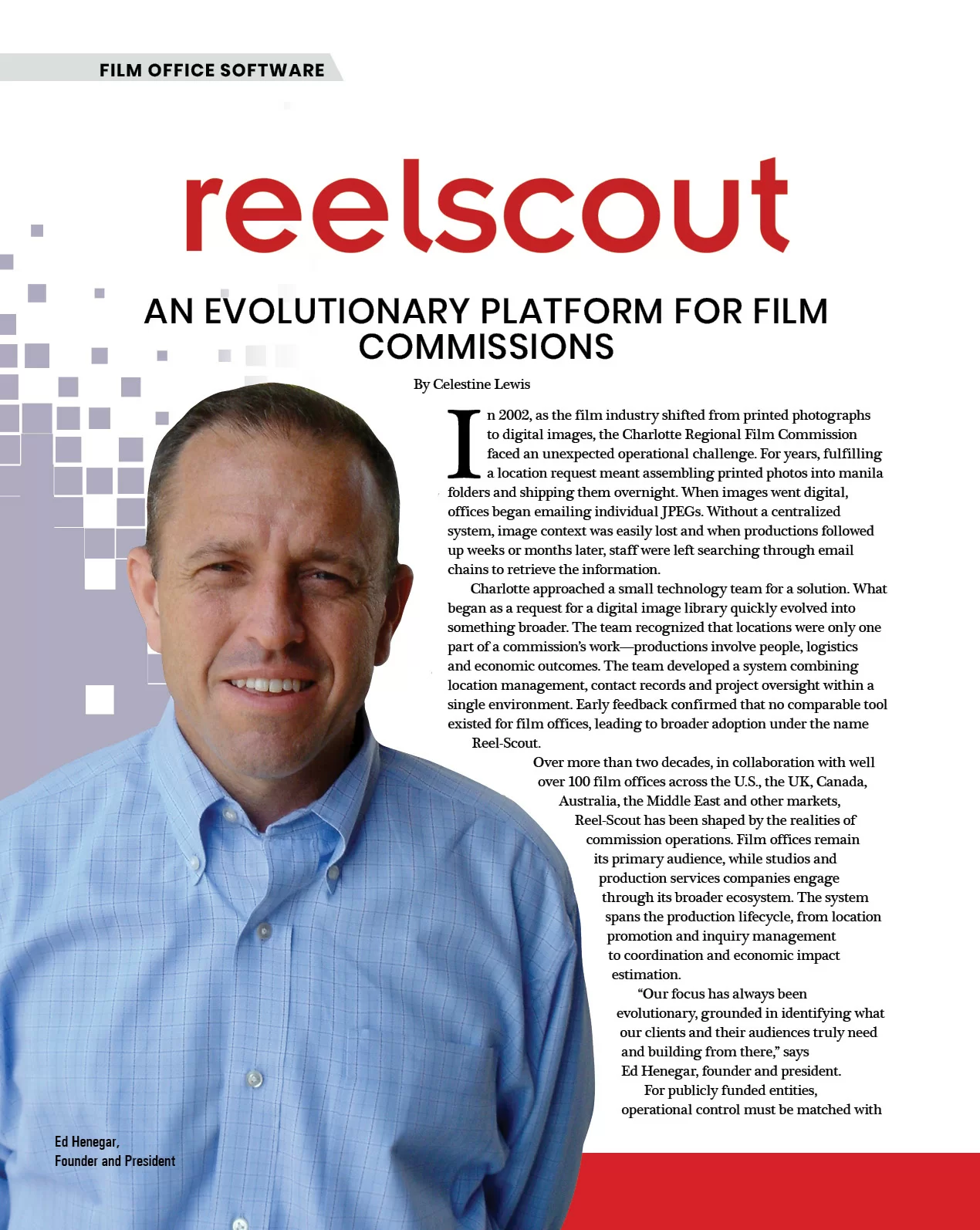
 Ed Henegar, Founder and President
What operational challenges did digital images create for film commissions managing location data?
In 2002, as the film industry shifted from printed photographs to digital images, the Charlotte Regional Film Commission faced an unexpected operational challenge. For years, fulfilling a location request meant assembling printed photos into manila folders and shipping them overnight. When images went digital, offices began emailing individual JPEGs. Without a centralized system, image context was easily lost and when productions followed up weeks or months later, staff were left searching through email chains to retrieve the information.
Charlotte approached a small technology team for a solution. What began as a request for a digital image library quickly evolved into something broader. The team recognized that locations were only one part of a commission’s work—productions involve people, logistics and economic outcomes. The team developed a system combining location management, contact records and project oversight within a single environment. Early feedback confirmed that no comparable tool existed for film offices, leading to broader adoption under the name Reel-Scout.
How did Reel-Scout evolve to address broader production lifecycle needs beyond location management?
Over more than two decades, in collaboration with well over 100 film offices across the U.S., the UK, Canada, Australia, the Middle East and other markets, Reel-Scout has been shaped by the realities of commission operations. Film offices remain its primary audience, while studios and production services companies engage through its broader ecosystem. The system spans the production lifecycle, from location promotion and inquiry management to coordination and economic impact estimation.
 “Our focus has always been evolutionary, grounded in identifying what our clients and their audiences truly need and building from there,” says Ed Henegar, founder and president.
For publicly funded entities, operational control must be matched with budget predictability. Reel-Scout operates under a structured annual subscription that includes updates, storage, security and enhancements, allowing commissions to forecast technology costs while maintaining visibility into production activity.
Turning Production Activity into Structured Insight
Why is centralized data important for tracking production activity and economic impact across projects?
Reel-Scout is designed for complex administrative environments. Its locations module allows commissions to catalog properties with mapped and geocoded data while selectively publishing public-facing galleries, enabling strategic promotion without compromising control.
-
Our focus has always been evolutionary, grounded in identifying what our clients and their audiences truly need and building from there.
The contacts module centralizes records of industry professionals, government officials and regional stakeholders. Within the project management module, productions are tracked from inquiry through completion. Commissions monitor production days, hotel room nights, vendors, suppliers and estimated economic impact while documenting operational variables such as permits, road closures and location usage. Projects won and lost are recorded alongside the reasons behind those outcomes, whether tied to incentives, infrastructure or location availability, creating a foundation for competitive assessment.
Each production remains archived long after wrap, allowing historical filmographies and site usage to be retrieved without relying on disconnected systems.
 Dashboards provide real-time visibility across locations, contacts and projects. When a commission sends a branded location package link, productions can favorite locations or individual images, with feedback automatically returning to the system, replacing fragmented email exchanges with structured engagement.
As incentive competition has intensified globally, Reel-Scout has expanded to include incentive-tracking functionality. Commissions can document their incentive activity and see how their offerings stack up against other jurisdictions, giving them clearer insight into their market positioning. A tourism module captures post-release engagement at filming sites, linking incentive strategy with long-term economic participation and completing the production cycle.
Strengthening Industry Collaboration
In what way does Reel-Scout’s ecosystem improve collaboration between studios and film commissions globally?
RS Studio, a sister system for production services companies and studios, extends the Reel-Scout ecosystem beyond film offices. Major industry players, including Netflix, use RS Studio to manage global location libraries. Where authorized, studio users can view location data within participating commission systems, creating a direct pathway between large-scale productions and local film offices.
Public galleries and RS Studio operate in coordination, reducing friction between inquiry and production. Complementing this ecosystem is LocationsHub, a marketplace that aggregates publicly available locations from participating clients into a centralized platform, increasing cross-market discoverability while preserving local control over private assets.
Reel-Scout helps film offices manage what they already do—locations, people and projects—in one place, enabling them to operate effectively in a data-accountable, incentive-driven global production environment.
Choosing Film Office Software That Aligns Strategy, Data and Industry Access
Public film offices sit at a complex intersection of economic development, creative production and public accountability. Most operate within government structures, answer to budget oversight and compete globally for projects that weigh incentives, infrastructure and speed of response. The systems that support this work cannot be treated as simple image repositories or contact databases. They shape how effectively an office attracts productions, manages relationships and demonstrates impact to stakeholders.
Many offices evolved from manual or fragmented processes. Location images were once stored in filing cabinets, contacts tracked in personal address books and project details managed through disconnected spreadsheets. Digital tools replaced paper but often preserved the fragmentation. Images lived in one environment, contacts in another and project tracking somewhere else. When a production revisited an inquiry months later, staff frequently searched through email threads and shared drives to reconstruct what had been sent and discussed. The inefficiency was not just administrative; it slowed response time and diluted institutional memory.
Executives evaluating film office software should expect a unified environment where location assets, industry contacts and active projects are interconnected rather than siloed. Location libraries need structured metadata, geocoding and mapping so staff can respond to highly specific creative requests. Contact records should capture production companies, crew, public officials and vendors in a way that supports long-term relationship management. Project tracking must extend from initial inquiry through filming and wrap, including permits, production days and vendor usage. When these elements function within a single system, offices gain continuity and visibility across the entire production lifecycle.
Public accountability introduces another layer. Film offices are often required to demonstrate economic impact, justify incentive allocations and report on lost opportunities.
"A data-rich environment supports internal decisionmaking and external reporting without forcing staff into parallel systems."
Software should therefore provide clear dashboards and reporting capabilities that show project pipeline status, production activity and historical filmography. Understanding why a project chose another jurisdiction can inform policy decisions just as much as tracking completed productions. A data-rich environment supports internal decision-making and external reporting without forcing staff into parallel systems.
Industry exposure also matters. Location promotion no longer stops at sending curated packages. Productions expect interactive galleries, searchable databases and efficient feedback loops. The ability to control which locations are public, which remain private and how information is presented under the film office’s own brand can influence perception and trust. Broader marketplace visibility, where appropriate, can surface opportunities that might otherwise bypass a region entirely.
Budget predictability is a persistent constraint. Government entities need transparent subscription models that include upgrades, storage, security and support without recurring add-ons that complicate annual planning. Software that consolidates multiple functions reduces the need for supplementary tools and lowers administrative overhead.
Reel-Scout, Inc. stands out as a platform built specifically around these realities. It integrates location management, contact records and project tracking within one system, reflecting how film offices actually operate. Its outward-facing location libraries allow offices to promote selected assets while retaining control over sensitive data. The project module captures production activity, vendor engagement and estimated economic impact, giving offices a consolidated view from inquiry to completion. It extends industry reach through its Locations Hub marketplace and enables collaboration with major studios through RS Studio, creating structured pathways between film offices and production entities. For executives responsible for modernizing their office infrastructure, it represents a focused, field-tested solution aligned with both public accountability and industry access.
...Read more
Film Office Software Info
Q1
What makes Reel-Scout, Inc. a recognized name in film office software?
Reel-Scout, Inc. earned recognition in film office software by building a platform specifically around the operational realities of film commissions and production-facing government offices. Rather than functioning as a simple image archive, the system integrates location management, project tracking and contact organization within a unified cloud environment. Its platform was originally developed to solve inefficiencies created by fragmented digital workflows, particularly when productions revisited location inquiries months after initial communication. Over time, Reel-Scout expanded into a broader ecosystem that helps film offices manage production activity, economic reporting and industry engagement from a single platform.
Q2
How does Reel-Scout support film commissions and production offices more effectively?
Centralized workflow management sits at the core of Reel-Scout’s film office software. The platform allows organizations to manage locations, production contacts, incentive activity and project data without relying on disconnected spreadsheets or isolated systems. Film offices can create searchable location galleries, track production timelines and generate branded location packages directly within the software. Real-time dashboards and reporting tools also help organizations monitor production activity, estimate economic impact and maintain historical project records. This integrated structure improves administrative continuity while helping offices respond more efficiently to production inquiries.
Q3
Why is location management such an important part of Reel-Scout’s platform?
Location visibility plays a major role in production attraction, and Reel-Scout addresses that need through film office software designed around searchable, structured location management. The platform enables film offices to organize properties with geocoded mapping, metadata tagging and customizable public galleries. Productions can review curated location packages while commissions maintain control over private or sensitive assets. Reel-Scout also supports interactive engagement through branded location links that allow productions to favorite and review specific locations directly within the system. This structured approach reduces fragmented communication and improves response efficiency during active production scouting.
Q4
How does Reel-Scout help organizations measure production impact and reporting activity?
Public accountability and economic reporting are major operational priorities for many film offices, and Reel-Scout incorporates those functions directly into its film office software. The project management module tracks production days, vendor activity, hotel usage and estimated economic impact throughout the production lifecycle. Offices can document projects won and lost while analyzing factors tied to incentives, infrastructure or location availability. Reporting capabilities also provide visibility into production trends, inquiry activity and regional engagement. By consolidating this information within one platform, Reel-Scout helps organizations maintain stronger historical records and more reliable operational insight.
Q5
What role does cloud technology play in Reel-Scout’s service model?
Cloud accessibility is central to Reel-Scout’s film office software because film commissions and production teams often operate across multiple locations and time zones. The SaaS platform allows authorized users to access projects, contacts and location data securely from anywhere without requiring local installation or manual synchronization. Secure hosting, automated backups and centralized collaboration tools help maintain continuity across distributed teams. The company also supports mobile accessibility through RS Mobile, which extends branded location and crew information into app-based environments for participating film offices. This cloud-first approach improves accessibility while simplifying long-term system management.
Q6
Why is Reel-Scout relevant in today’s production and film commission environment?
Film offices now operate within increasingly competitive global production markets, and Reel-Scout addresses those demands through film office software built around collaboration, data visibility and production engagement. Its ecosystem extends beyond commissions through tools such as RS Studio and LocationsHub, which create structured connections between film offices and larger production entities. The platform also supports long-term relationship management by linking locations, contacts and production history within one environment. As productions expect faster responses, interactive location access and more transparent coordination, Reel-Scout remains aligned with the operational and reporting needs of modern film commissions.
Company :
Reel-Scout, Inc.
Management Ed Henegar, Founder and President
Description
Reel-Scout is a production management platform built for film commissions and studios. It centralizes location libraries, contact records and project tracking within a single system. Used by more than 100 film offices globally, it supports incentive analysis, economic impact reporting and cross-market collaboration through its extended ecosystem, including RS Studio.