

Thank you for Subscribing to Media Entertainment Business Review Weekly Brief

Paramount Global
John B. Narus, Vice President, Digital Transformation, Product Platforms, Portfolio Management
Implementing Jira Align

John B. Narus
John B. Narus is the Vice President, Digital Transformation, Product Platforms, Portfolio Management at Paramount Global. With over two decades of experience in digital media technology and at the forefront of streaming, driving launches for HBO GO and Cinemax GO both domestically and internationally. John has overseen product management, program management, quality assurance, data analytics, strategic partners, and technical customer support for name-brand global companies. At Paramount Global, he leads the PMO team, setting best practices & standards in software product development, agile delivering, agile coaching, and training.
If you work in software development following an agile development methodology, then you likely use Atlassian’s Jira product or you have used it in the past. Jira allows teams to define their work in manageable chunks, planned either on a Sprint bassis or Kanbanstyle board to visualize the flow of work. Jira is typically focused at the team level, with a view to a few increments of work. Why Jira Align? Where Jira itself begins to hit limitations is from a team of teams perspective. Scaling agile across the enterprise to many or hundreds of teams is not something you can easily plan and visualize within Jira. If you are working within a product development organization on a consumer product with wide adoption with regards to a number of users and wide adoption globally, then you are operating in a team of teams scenario. In order to address this need, Jira Align ( JA) has been introduced.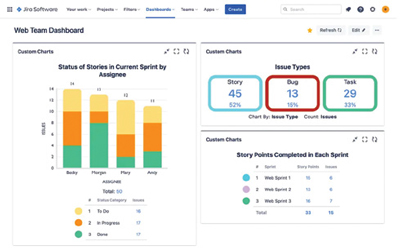 Jira Align Capabilities
JA is intended to connect business strategy to customer outcomes at scale. It has the ability to capture strategy and tie it to execution through OKRs. There are a slew of features focused on long-term planning, road mapping, risk, and issue and dependency management.
Data is synchronized between Jira and JA based on your designation of specific projects and boards. JA extends Jira to manage program, portfolio and enterprise-level planning activities. The tool is designed specifically to support teams following SAFe (Scaled Agile) methodologies, although capabilities are still valuable to teams following other methodologies.
Dependency, Issue & Risk Management
Dependencies between teams and/or programs, both internally as well as externally (e.g., partners, vendors), are typical in the enterprise. JA has a few different views to visualize dependencies and track details. You can track the owner, time frame for delivery (committed Sprint and Quarter), and current tracking status. This allows teams to stay on top of dependencies and manage any associated risks. JA takes the SAFe ROAM-based approach to risk management by designating risks as resolved, owned, accepted or mitigated.
Long Term Planning
From a long-term planning perspective, JA allows you to plan multiple quarters out. You achieve this by leveraging their roadmapping tool and the program board. The latter is intended to represent the agreed-upon plan between product management and development teams for the current program increment (PI), aka quarter. The program board visualizes the status of features, dependencies, objectives and milestones by using different symbols and color-coding. You can see the different agile teams, what they plan to deliver and when. Issues, blockers, canceled, and orphaned items are color-coded to easily identify items needing attention.
Jira Align Capabilities
JA is intended to connect business strategy to customer outcomes at scale. It has the ability to capture strategy and tie it to execution through OKRs. There are a slew of features focused on long-term planning, road mapping, risk, and issue and dependency management.
Data is synchronized between Jira and JA based on your designation of specific projects and boards. JA extends Jira to manage program, portfolio and enterprise-level planning activities. The tool is designed specifically to support teams following SAFe (Scaled Agile) methodologies, although capabilities are still valuable to teams following other methodologies.
Dependency, Issue & Risk Management
Dependencies between teams and/or programs, both internally as well as externally (e.g., partners, vendors), are typical in the enterprise. JA has a few different views to visualize dependencies and track details. You can track the owner, time frame for delivery (committed Sprint and Quarter), and current tracking status. This allows teams to stay on top of dependencies and manage any associated risks. JA takes the SAFe ROAM-based approach to risk management by designating risks as resolved, owned, accepted or mitigated.
Long Term Planning
From a long-term planning perspective, JA allows you to plan multiple quarters out. You achieve this by leveraging their roadmapping tool and the program board. The latter is intended to represent the agreed-upon plan between product management and development teams for the current program increment (PI), aka quarter. The program board visualizes the status of features, dependencies, objectives and milestones by using different symbols and color-coding. You can see the different agile teams, what they plan to deliver and when. Issues, blockers, canceled, and orphaned items are color-coded to easily identify items needing attention.
A big piece of the learning curve with JA is that it is completely different from Jira, and there are many features packed into the product
The articles from these contributors are based on their personal expertise and viewpoints, and do not necessarily reflect the opinions of their employers or affiliated organizations.
