


Thank you for Subscribing to Media Entertainment Business Review Weekly Brief
Cloud production’s success depends on how reliably live video can be transported and delivered with frame-accurate synchronization. BitFire, a next-generation live video technology company, had already solved this problem before it expanded into cloud production.
Founded in 2020 as a transmission network, it was built to deliver live video over IP with the control and reliability that defined traditional broadcast. As the industry moved toward fragmented, self-managed workflows, BitFire engineered a system that kept every feed frame-accurate and managed signals with precision. That engineering discipline became the foundation for everything that followed.
“Our goal has always been to bring the quality and reliability of traditional professional transmission into modern workflows. That level of service underpins our entire platform and it’s something we’ve been intentionally preserving as we scale,” says Jim Akimchuk, president and CEO.
A Deterministic-Latency First Transport Network
Most internet-based transmission systems build buffers and compensate at the receiving end. BitFire works backward from latency. The entire system is engineered outward from that core design element.
 The platform’s user datagram protocol-based system assigns every incoming signal a consistent time reference, keeping all sources in sync from the moment they enter the system. When BitFire designates a 300-millisecond transport, it is exactly that, precise to the frame and accurate to the clock. It is not 300 milliseconds plus travel time or a buffer.
The platform runs on a globally distributed infrastructure spanning across AWS regions and additional edge locations. When a packet is lost, the system recovers it hop by hop, closer to the point of loss, as a content delivery network does. The result is faster recovery and better performance at scale.
“Because latency is the core design element, the system scales across geographies without introducing timing inconsistency. No single component can go down and take everything with it. Fault tolerance is built into the architecture,” says Colin Bonzey, Vice President of Operations.
Orchestrating Complexity into Operator Control
BitFire’s centralized orchestration layer controls how signals move across the entire workflow. Originally built to manage distributed transmission, it now acts as the system’s control plane, making cloud production an operational task rather than an engineering one. For broadcasters, sports organizations, newsrooms and enterprise clients, this means internet-native workflows that replace the physical infrastructure of traditional control rooms and trucks.
Production teams define what they need. The platform handles the rest. Signals move through a source-to-destination model, with encoding, transport and system coordination running automatically in the background. Operators work without dealing with IP addresses, ports, firewall rules or multi-vendor security policies. Network address translation traversal is handled natively, with no requirement for public or static IPs. Endpoints establish secure outbound connections, allowing them to integrate from virtually any network without additional configuration. Because the orchestration layer controls the entire pipeline, production intent is translated directly into infrastructure. A team specifying a 24-input switcher gets 24 destinations, each connectable to any port on physical hardware or secure reliable transport, without manual configuration. Spinning up that environment on other platforms takes days or weeks. In BitFire’s Spark Builder, it’s a single button.
This capability addresses three distinct production needs. Automated production runs programmatically via API. Teams build shows from upstream data without needing the same crew for each event. International remote integration brings multi-city, multi-site productions together in the cloud, with on-site crew, remote talent and distributed graphics all operating from a single environment. At scale, one production blueprint replicates across many simultaneous outputs. In one deployment, a client produced 17 localized world feeds, each with its own commentary and production layer, from a single source, without additional physical infrastructure.
Communication systems, tally and data integrations are built into the same environment, keeping on-ground crews, control rooms and remote operators connected without additional coordination overhead.
Cloud-Native Tools, Built from the Ground Up
BitFire’s production tools are cloud-native and software-defined, engineered from scratch to run and be controlled from anywhere.
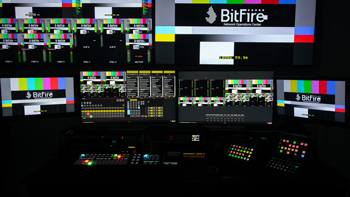
The architecture is modular by design. The switcher, multi-viewer, clip recorders, players and replay system each operate as independent components, the way a physical control room or truck is organized. If one component fails, the failure stays contained. Failures are isolated to individual components, preventing system-wide disruption and taking production off the air.
-
Our goal is to bring the discipline of traditional professional transmission into modern workflows. That level of control and reliability underpins our entire platform and it’s something we’ve been intentionally preserving as we scale.
Everything from the compositors up was written in-house. Multi-viewers that appear in a web window run at 1080p60 on the back end. All tools operate at full broadcast grade in software.
A TCP-based API allows any automation system or external controller to interface with the platform as if it were physical equipment. All servers run Linux. Operators work through a web interface, a TCP API or a native physical control panel.
Turning Visibility into Operational and Cost Control
Operators have real-time insight into every stage of the signal path. Metrics such as latency, packet loss, jitter and bitrate stability are continuously tracked at every hop in the network. Because the network is multi-hop, operators can identify exactly where a problem originates, whether at the venue, in transit or at the destination and understand its nature before acting.
If bandwidth is constrained, operators can reduce the bitrate without disrupting transmission. If latency is the issue, increasing buffer time stabilizes the feed. These are production decisions and the platform presents the situation clearly enough for directors and technical managers to make them directly.
The same principle extends to cost. Cloud production has long carried the risk of unexpected infrastructure bills. BitFire makes costs fully transparent at the point of configuration. Teams know what they are building and what it will cost before anything is deployed. The platform also manages the AWS side for teams that opt for it. There are no surprises when the bill arrives.
An Extension of the Production Team
BitFire operates as an extension of a client production team. A broadcast-grade network operations center, staffed by engineers who understand the difference between SDI and internet issues, has been in place since day one. A full TechOps team works alongside clients to build and deploy environments when needed.
“We don’t charge extra for that level of support; it’s core to who we are and what we do. When you’re using our system, you have direct access to experienced engineers who help you build, deploy and refine your setup,” says Akimchuk. “Even if you prefer to use Spark Builder independently, you can do that with confidence, because if you need help, you’re one call away from expert support. BitFire gives you control when you want it and help when you need it.”
BitFire calls this model definitive care, a term borrowed from the public safety industry. Whatever the problem and whenever it occurs, the support needed to resolve it is there. That principle has guided the business since its founding. Teams get control when they want it and help when they need it.
Setting the Direction for Cloud Production
Cloud production is now defined by what can be executed reliably under real-world conditions. BitFire addresses that at the architectural level. Unifying transport orchestration and production into a single cloud-native system removes the fragmentation that limits scale and introduces instability.
BitFire builds for the cloud rather than adapting legacy approaches to fit it. That clarity of purpose is what makes BitFire a standout choice for Cloud-Based Production Platform of the Year 2026.
Engineering Control and Certainty in Cloud Production Platforms
Cloud-based production has moved from experimental workflows to a core pillar of modern media operations, yet many implementations still struggle to match the predictability and control of traditional broadcast environments. For executives overseeing production strategy, the challenge is no longer access to cloud tools but confidence in how those tools behave during live operations, particularly when live output depends on distributed infrastructure.
A persistent fault line in the market lies in how platforms handle signal transport into and out of the cloud. Many solutions treat transmission as an external dependency, introducing latency variability and forcing production teams to compensate downstream. This often results in synchronization issues, delayed feeds or reactive troubleshooting during live events. A more reliable approach treats latency as a fixed parameter rather than a variable outcome, ensuring that feeds remain aligned at the point of origin and throughout the workflow. Systems built with this philosophy enable production teams to make timing decisions deliberately rather than adapt to drift.
Control surfaces have become a decisive factor. As production environments expand across regions, orchestration complexity increases, often requiring specialist networking knowledge beyond traditional broadcast skill sets. Platforms that translate this complexity into familiar routing logic allow technicians to operate distributed systems as if they were working within a physical control room. When signal paths, switching logic and resource allocation are abstracted into intuitive interfaces, production teams regain agency without relying on deep IT intervention. This shift reduces friction in both setup and execution, particularly in fast-turnaround scenarios.
"A more reliable approach treats latency as a fixed parameter rather than a variable outcome, ensuring that feeds remain aligned at the point of origin and throughout the workflow."
Cost predictability remains another unresolved concern. Cloud production has long promised financial flexibility, yet opaque billing structures and fragmented vendor stacks frequently undermine that expectation. Executives require clarity not only at deployment time but throughout the lifecycle of a production environment. Systems that surface real-time cost visibility alongside technical configuration enable informed decision-making before resources are committed. This transparency can align engineering teams with financial oversight, reducing the risk of unexpected expenditure during large-scale productions.
Reliability, however, extends beyond infrastructure design into operational support. Traditional broadcast models have always included dedicated engineering oversight, a standard that many cloud platforms have yet to replicate. Continuous monitoring, accessible expertise and ability to intervene in real time remain critical for maintaining broadcast integrity. Platforms that integrate these elements into their service model provide a level of assurance that purely self-managed systems often lack. This becomes especially important in multi-location productions where coordination gaps can quickly cascade into visible on-air disruptions.
BitFire enters this landscape from a transmission-first perspective, having built broadcast-grade, low-latency IP transport before expanding into software-defined production tools. Its architecture emphasizes deterministic end-to-end latency, frame-accurate synchronization, and multi-hop recovery across distributed environments, enabling consistent timing without downstream correction. Platform’s orchestration layer presents complex workflows through a simplified, “source to destination” model, allowing production teams to configure and manage environments without specialized networking expertise. Its Spark™ Production Environments and Inferno Command Center provide clear cost visibility during setup and administration, reducing uncertainty around cloud resource use and billing. A broadcast-grade support structure, including 24/7 NOC support, live statistics across every hop, and technical assistance for deployment and operation, reinforces reliability during live productions. This combination positions BitFire as a disciplined choice for organizations that require both control and predictability in cloud-based production.
...Read more
Cloud-Based Production Platforms Info
Q1
What Should Production Teams Expect From Cloud-Based Production Platforms?
Cloud-Based Production Platforms should do more than simply move production workflows into the cloud. They need to support contribution, routing, monitoring, production control and distribution without forcing teams to rebuild the habits that keep live production stable. When the fit is poor, problems show up quickly as delayed feeds, unclear signal paths or extra workload for engineers who are already managing a live event. The strongest platforms preserve the familiarity of a traditional control room while giving teams faster ways to build, adjust and scale productions in real time.
Q2
How Does BitFire Bring Live Production Into a Cloud Workflow?
BitFire connects Cloud-Based Production Platforms with real world broadcast operations. Its system combines cloud production tools with IP transmission so teams can manage both live production and signal transport within a single environment. Spark Production Environments include switching, audio mixing, replay, intercom and multiviewing capabilities. Inferno Command Center adds browser based routing, cloud resource management, FlightPath live statistics, administrative controls and billing visibility, which becomes important when production teams need flexibility without losing operational structure or cost oversight.
Q3
Which Tools Matter Most in Remote and Hybrid Production?
Remote and hybrid production depends on low latency contribution, reliable communication and familiar operational controls. Cloud-Based Production Platforms should allow crews to work across different locations while still monitoring feeds, communicating with talent and adjusting production elements quickly. Browser based access can reduce setup complexity, but the real test is whether teams can manage video and audio monitoring, control interfaces and contribution paths without adding unnecessary software layers. Strong platforms also support intercom systems, guest contribution workflows, multiview layouts and rapid changes during rehearsals and live events.
Q4
Why Are IP Transmission and Synchronization So Important?
Live production is highly sensitive to timing issues where even small delays or sync errors can affect the final output. Cloud-Based Production Platforms rely heavily on IP transport because production quality depends on the stability of incoming signals. Frame accurate synchronization, secure private connectivity and real time routing help teams manage multiple camera feeds, remote guests and distribution paths with fewer surprises during live broadcasts. In environments like sports, news and entertainment, even minor transport issues can become visible on screen and impact viewer experience.
Q5
How Should Buyers Evaluate Cloud-Based Production Platforms?
Evaluation should extend beyond polished demonstrations. Teams should test Cloud-Based Production Platforms using real feeds, realistic latency expectations and actual routing changes similar to those needed during live events. It is important to understand how resources are provisioned, how costs are controlled, how network issues are detected and how quickly feeds can be started, stopped or redirected when production needs shift. Effective evaluation should involve engineers, producers and finance stakeholders since cloud production directly impacts operations, staffing and budget decisions at the same time.
Q6
Where Does BitFire Stand Out for Broadcast-Grade Cloud Production?
BitFire stands out by keeping Cloud-Based Production Platforms closely aligned with traditional control room workflows while enabling flexibility in cloud environments. FireBridge Connect allows browser based monitoring, virtual control panels, intercom access and webcam based contribution for authorized users. BitFire Transport supports low latency video and audio transmission over IP, while its network support model helps production teams focus on the event itself rather than the underlying infrastructure, making it useful for remote production, hybrid workflows and multi feed live events.
Company :
BitFire
Management Jim Akimchuk III, President and CEO
Colin Bonzey, Vice President of Operations
Description
BitFire builds cloud-native production infrastructure that moves live video with precision, control and consistency. Starting from a transmission-first foundation, it combines synchronized transport, centralized orchestration and modular production tools into a single platform, allowing broadcasters to scale and operate complex live workflows without the unpredictability typically associated with cloud-based production.